Child safeguarding is a fundamental obligation of sporting organisations at every level of the sport system e.g. clubs, leagues, state and national bodies, and global sport organisations. In practice, however, safeguarding is never “owned” by one actor, it is a shared responsible of all stakeholders within the sports system. As such, safeguarding is produced (or undermined) by the interactions between all stakeholders, governance, compliance, resourcing, recruitment, reporting pathways, culture, and day-to-day sporting environments etc.
This blog presents a systems thinking lens on child sexual abuse (CSA) in sport, why it persists despite policy growth, what consistently enables it, and what might change when we treat safeguarding as a systems problem rather than a compliance problem.
This blog is based on the important work from Karl Dodd’s PhD (see papers below).
Dodd, K., Salmon, P. M., Solomon, C., & McLean, S. (2025). Applying a systems thinking lens to child sexual abuse in sport: An analysis of investigative report findings and recommendations. Child Abuse & Neglect.
Dodd, K., Solomon, C., Naughton, M., Salmon, P. M., & McLean, S. (2023). What enables child sexual abuse in sport: A systematic review. Trauma, Violence, & Abuse.
What is child sexual abuse in sport?
The World Health Organization (WHO) definition is clear:
The involvement of a child in sexual activity that he or she does not fully comprehend, is unable to give informed consent to, or for which the child is not developmentally prepared, or else that violates the laws of social taboos of society. Children can be sexually abused by both adults and other children who are by virtue of their age or stage of development—in a position of responsibility, trust or power over the victim.
Sport is a high-trust environment. It creates legitimate reasons for adults to have access to children (training, coaching, travel, selection, treatment), often in settings where privacy is normalised (changing rooms, transport, hotels, messaging apps etc). Sport’s everyday operations can unintentionally create conditions where safeguarding can be undermined and where perpetrators can exploit.
How common is CSA in sport?
Prevalence estimates are tough to obtain and vary by study and context, but two studies are difficult to ignore.
- A 2021 survey of 10,302 athletes across six European countries reported CSA prevalence rates of 20% for touching sexual offences and 35% for non-touching sexual offences (Hartill et al, 2021).
- In Australia, one study found 38% of participants surveyed (n=886) had experienced sexual violence within a sporting environment (Pankowiak et al, 2022).
These figures do not tell us everything. But they do tell us that safeguarding cannot be framed as a niche risk that a policy document will contain.
What enables CSA in sport?
Dodd’s analyses identified enabling factors across the broader sports system and mapped them using a systems thinking-based accident mapping framework (AcciMap). The most common identified enabling factors to CSA in sport were authority and power, sexual harassment, isolation, grooming and coercion, organisational culture, and athlete (lack of) knowledge of CSA (Figure 1).
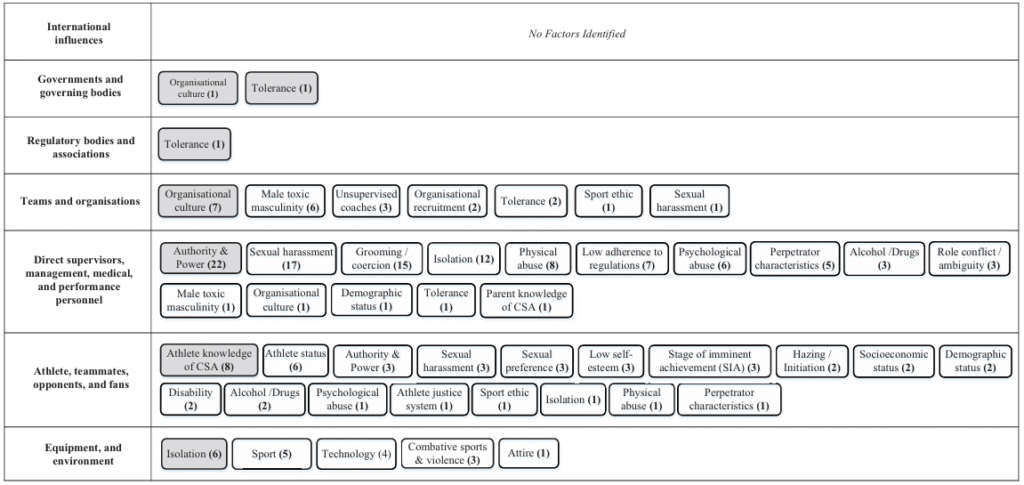
Figure 1. AcciMap showing the enabling factors to child sexual abuse in sport identified in a systematic literature review of 47 peer reviewed articles (Dodd et al, 2023).
This finding is important because it points away from a simplistic explanation of one single person’s actions and towards a recurring systemic pattern: abuse is enabled when power and access concentrate, when environments isolate, when cultural signals discourage speaking up, and when athletes cannot recognise or name what is happening.
A critical nuance is where the evidence base is strongest. Most enabling factors identified in the wider CSA literature sit close to the bottom levels of the sport system, relationships and environments around training and competition, while understanding of higher-level enabling factors remains under-developed. That gap can inadvertently steer organisations toward individual-level interventions while leaving higher system-level conditions intact.
What investigative reports into CSA add to the picture
Official investigative reports often reveal true systemic conditions that everyday practice normalises, and that is not always picked up in peer reviewed literature. E.g. how governance, resourcing, reporting pathways, and institutional incentives shape safeguarding outcomes.
Dodd’s analysis of investigative reports from five Australian sports (Swimming, Cricket, Gymnastics, Football, Tennis), identified 30 enabling factors to CSA, with the majority focused at higher levels of the sports system, such as governance, policy, and reporting/handling issues (Figure 2).
Importantly, there was consistency across the sports. Governance and policy issues, authority and power, grooming/coercion, and isolation appeared were identified across all five sports. This is a strong signal that safeguarding can improve through cross-sport learning, rather than each sport repeating the same cycle of crisis, inquiry, reform, and fade. Further, was the identified gap between peer reviewed literature and investigative reports. The investigative reports identified far more enabling factors at the higher levels of the system, especially at the governance and regulatory body levels of the system.
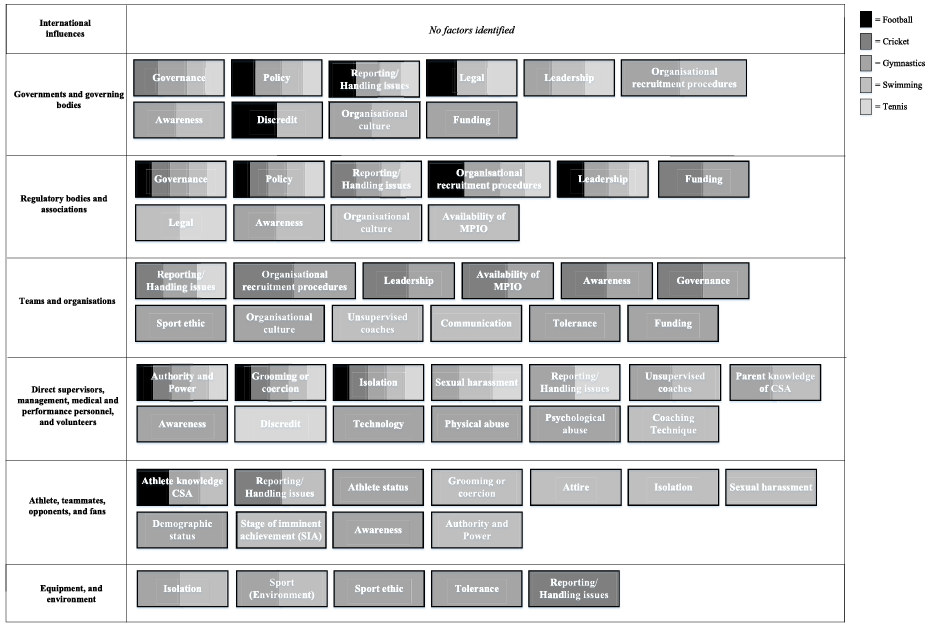
Figure 2. AcciMap showing the enabling factors to child sexual abuse across sports identified from investigative reports in five Australian sports (Dodd et al, 2025).
Why safeguarding drifts
Safeguarding failure is rarely a single system component failure. More often it is gradual migration from safer to less safe states under systemic pressure. Dodd’s analysis describes how attitudes, behaviours, operations, and practices can shift from safe to unsafe over time due to pressures such as financial constraints, workforce/volunteer availability, leadership, governance, tolerance, and performance pressures. It also highlights how funding and resourcing limitations can stress the boundaries of a safe environment and undermine policy implementation.
This is why having a better policy is not the same as reducing risk in the real world. Policies are only effective when they are implemented under realistic conditions, with accountability and continuous learning from feedback mechanisms.
What recommendations focus on, and what is missing
Across the investigative reports of the five sports, 331 recommendations were categorised into 11 themes, including education/training, policy/procedure, governance, oversight, and information/reporting services. Most recommendations sat at the upper levels of the system and targeted governments/governing bodies and regulatory bodies/associations.
High-level recommendations can be appropriate system levers that can reshape environments at scale. But a weak point remains: few recommendations targeted feedback mechanisms such as information/reporting services, representation, and personnel management. In any complex system and especially safeguarding, feedback is important. It is how the system detects emerging risk, identifies weak implementation, and prevents drift into unsafe conditions.
What can be done: a systems approach
If CSA is enabled by multi-level factors, then prevention must be multi-level too. The practical shift is to treat safeguarding as a socio-technical system with effective controls and functioning feedback loops.
Safeguarding improves when power and access are constrained by design, reducing opportunities for isolation and unobserved interactions. It improves when reporting pathways are trusted and easy to use, and when responses are timely, fair, and transparent because weak feedback creates organisational blindness. It improves when implementation is designed for the constraints of community sport, where volunteers and time-poor staff carry much of the load, and where “perfect compliance” is an unrealistic assumption.
Finally, safeguarding needs active monitoring. Pressures will push systems toward the margins of safety, and perpetrator tactics evolve. Without routine review and learning cycles, defences degrade quietly, right up until the next scandal.
Final thoughts
Safeguarding is a living system. When that system has robust controls and strong feedback, abuse becomes harder to enact, easier to detect, easier to report, and quicker to learn from. When feedback mechanisms are weak, sport can build impressive compliance architectures while remaining blind to what is happening on the ground.
The task ahead is not simply more safeguarding policy. It is better system design.

Dr Scott McLean
is the Director of sports consulting company Leverage Point Consulting and Adjunct Associate Professor at the Centre for Human Factors and Systems Science at the University of the Sunshine Coast (UniSC). Scott works internationally in sport across complexity and systems thinking, integrity, athlete health and wellbeing, and organisational performance.
References
- Dodd, K., Salmon, P. M., Solomon, C., & McLean, S. (2025). Applying a systems thinking lens to child sexual abuse in sport: An analysis of investigative report findings and recommendations. Child Abuse & Neglect, 165, 107488.
- Dodd, K., Solomon, C., Naughton, M., Salmon, P. M., & McLean, S. (2023). What enables child sexual abuse in sport: A systematic review. Trauma, Violence, & Abuse.
- Hartill, M., et al. (2021). Child sexual abuse prevalence survey across six European countries.
- Pankowiak, A., et al. (2022). Psychological, physical, and sexual violence against children in Australian community sport.