Why do some sport initiatives transform entire organisations while others, often just as well-funded, barely make a dent? It turns out the difference often isn’t in the quality of the idea or the commitment of the people involved, but in where we intervene in the system.
Naughton and colleagues1 brought the ‘Leverage Points’ framework, developed by systems scientist Donella Meadows2, into the world of sport. The study analysed the most highly cited research papers from eight different sport-related fields including sports science, sports medicine, sport policy, and sport management to see which parts of the system interventions were targeting. The verdict? Much of the work in sport operates at the shallow end of the leverage spectrum, focusing on small adjustments to isolated parts of the system. While these interventions can be useful, they rarely create the type of lasting, large-scale change many practitioners are aiming for.
Understanding Shallow and Deep Leverage Points
In any complex system, whether it’s a professional football club, a national sports organisation, or the sport’s global governing body, there are different types of intervention points.
Shallow leverage points include things like adjusting training loads, changing equipment specifications, or refining nutrition plans. These are relatively easy to implement and measure, but their impact is often narrow and short-lived. Deep leverage points involve changing the underlying structures, rules, goals, or even the shared beliefs and values of the stakeholders within the system. These are harder to reach but can produce transformative change that ripples across the entire sport. For example, improving a player’s sprint speed is a shallow leverage point. Redesigning a youth development system so a club consistently produces first-team players is a deep leverage point.
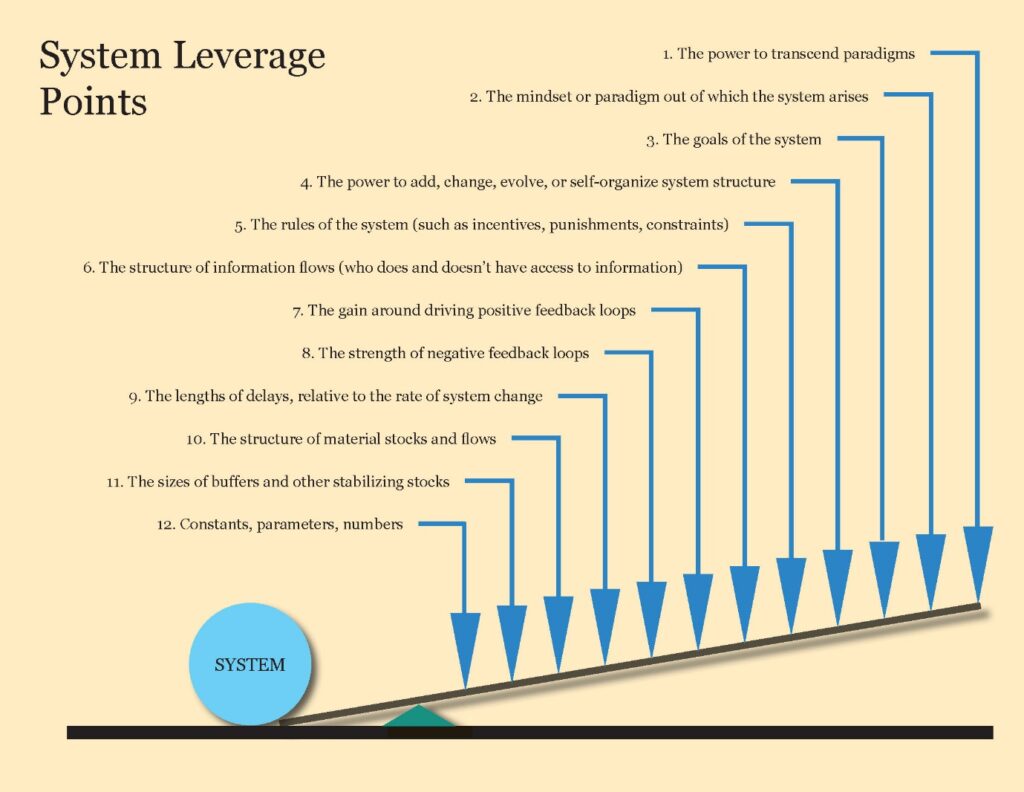
Figure 1. Meadow’s 12 leverage Points.
A Simplified Map of Leverage Points in Sport
Building off of Meadow’s Leverage Points, Abson et al. (2017) suggested the 12 leverage points could be overlayed with four system “Realms of Leverage” (arranged from deeper to shallow): 1) mental models, 2) system design/structure, 3) feedback loops and 4) parameters
Table 2. Realm of leverage.
| Depth | Realm of Leverage | Examples in Sport |
| Shallow | Parameters (constants, numbers) | Player speed, injury rates, training loads, nutrition plans |
| Feedback Loops | Ticket pricing, funding models, promotion / relegation rules | |
| Deep | System Design/Structure | Anti-doping governance, player transfer rules, youth development pathways |
| Mental Models | Shifting from elite-only focus to community sport, changing values underpinning talent ID |
What the Research Found
We examined the ten most-cited original research articles from each of eight leading journals in their respective fields. Each paper was coded according to the deepest leverage point it addressed.
Here’s what they found:
| Journal | Parameters | Feedback Loops | System Design/Structure | Mental Models |
| British Journal of Sports Medicine | 9 | 1 | 0 | 0 |
| International Journal of Sport and Exercise Psychology | 3 | 0 | 4 | 3 |
| International Journal of Sport Nutrition and Exercise Metabolism | 6 | 4 | 0 | 0 |
| International Journal of Sport Policy and Politics | 0 | 3 | 3 | 4 |
| Journal of Sport Management | 1 | 2 | 0 | 7 |
| Journal of Sports Sciences | 8 | 2 | 0 | 0 |
| Motor Control | 4 | 2 | 1 | 0 |
| Sports Biomechanics | 10 | 0 | 0 | 0 |
The contrast is clear. Fields like sport management and sport policy/law are much more likely to focus on deeper leverage points, such as system design and mental models. In contrast, most of the work in sports science, medicine, nutrition, and biomechanics focuses on parameters and feedback loops, interventions that may optimise a component but rarely shift the behaviour of the whole system.
Why This Matters for Practitioners
If your role involves improving performance in the short term, e.g. preparing a team for an upcoming tournament, then shallow interventions can be the right choice. Adjusting training drills, refining recovery protocols, or introducing a new supplement can deliver measurable results quickly.
But if you are aiming to solve persistent problems, like reducing long-term injury rates, increasing participation, or changing a club’s culture, then deeper leverage points are where the real opportunity lies. These might involve redesigning pathways, changing incentive structures, or challenging the prevailing mental models that guide decision-making. Such changes are harder to make, take longer to bear fruit, and often face political resistance, but they are the interventions most likely to produce lasting, transformative impact.
Bridging the Gap Between Fast and Slow Change
One reason sport research often stays in the shallow end is that many practitioner-researchers, sometimes called “pracademics” need to “work fast” to solve immediate, high-pressure problems. For example, a sports scientist embedded with a team might be focused on next week’s game, not next decade’s system structure. In contrast, deep leverage interventions require a “working slow” approach, bringing in systems thinking expertise, mapping the interactions between parts of the system, and designing changes that can influence the whole.
The best results often come when these two approaches are combined4. Fast interventions address pressing needs, while slow, deep work ensures that when you pull the right lever, it moves the whole machine.
Practical Takeaways
For coaches, performance leaders, and administrators, the lesson is straightforward: before you act, ask yourself what level of the system you are trying to influence. If your goal is a quick performance boost, shallow levers are fine. If you want transformation, you’ll need to design for deeper change, often involving governance, incentives, and shared beliefs.
That means:
- Mapping the system before making changes, so you understand where the real levers are.
- Aligning the depth of your intervention with your desired outcomes.
- Expecting resistance when you aim at deeper change and planning for it.
- Looking for ways shallow interventions might build toward deeper change over time.
Final Thought
It’s tempting to focus on the visible, measurable aspects of sport e.g. training data, match stats, injury counts. But if we want to make a real difference, we need to look deeper. Systems thinking reminds us that the most powerful changes often start in places that are hard to see: the structures, rules, and mental models that shape the way sport works.
If you want small changes, tweak the parameters. If you want lasting impact, change the system.
Paper Citation
Naughton, M., Salmon, P. M., & McLean, S. (2024). Where do we intervene to optimize sports systems? Leverage Points the way. Journal of Sports Sciences, 42(7), 566-573.

Dr Scott McLean is the Director of Australian based sports consulting company- Leverage Point Consulting. Scott is also an Adjunct Associate Professor at the Centre for Human Factors and Sociotechnical Systems at the University of the Sunshine Coast (UniSC). Scott is recognised as a global leader in systems thinking and complexity in sport. He has worked and conducted research with numerous sporting organisations including English Premier League, the World Anti-Doping Agency, International Olympic Committee, Sport Integrity Australia, the Australian Institute of Sport, Athletics Australia, Cycling Australia, the French Anti-Doping Agency, Sport and Recreation Victoria, the English Institute of Sport, Scottish Rugby Union, the Defence Science & Technology Group, Office of US Naval Research and multiple elite clubs in football, AFL, netball, and Para Sport. As an academic, he has over 100 publications, including two books, numerous peer reviewed journal articles, book chapters, reports, conference articles and abstracts. Please feel free to get in touch with Scott via LinkedIn.
Reference List
Naughton, M., Salmon, P. M., & McLean, S. (2024). Where do we intervene to optimize sports systems? Leverage Points the way. Journal of Sports Sciences, 42(7), 566-573.
Meadows, D. H. (1997). Places to intervene in a system (in increasing order of effectiveness). Whole earth, 1, 78.
Abson, D. J., Fischer, J., Leventon, J., Newig, J., Schomerus, T., Vilsmaier, U., Von Wehrden, H., Abernethy, P., Ives, C. D., Jager, N. W., & Lang, D. J. (2017). Leverage points for sustainability transformation. AMBIO: A Journal of the Human Environment, 46(1), 30–39. https://doi.org/10. 1007/s13280-016-0800-y
Coutts, A. J. (2016). Working fast and working slow: The benefits of embed ding research in high performance sport. International Journal of Sports Physiology and Performance, 11(1), 1–2.